(FOR CONTENT PROVIDERS) Research-Backed Ways to Design Reflective, Brain-Building Questions for Incarcerated Adult Learners
Research-backed ways to design reflective, brain-building questions for incarcerated adult learners
Have you ever been explaining something—an opinion, a plan, a story—when someone stopped you and asked:
“But what do you really mean by that?”
Not to challenge you.
Not to prove you wrong.
Just enough to make you pause.
Suddenly, you’re no longer repeating what sounds right. You’re clarifying it. Testing it. Sometimes, even revising it as you speak.
That moment happens all the time in real life—at work, in conversations with friends, in moments of conflict or self-reflection.
In learning science, that moment has a name: Socratic questioning.
It’s the shift from saying words to examining meaning. From passive explanation to active thinking.
You’ll walk away with:
A clear, usable definition of the Socratic Method
Research-backed reasons it works for adult learners, especially in corrections
Practical ways to use it on Edovo—even with multiple choice
A few question shifts that can change how your courses feel to learners
What Is the Socratic Method? (And Why It Belongs in Your Course)
Socrates, aka the original GOAT of discussion threads, asked questions not to collect answers, but to deepen thinking. His whole approach boiled down to: Let’s dig under your assumptions and see what’s actually holding them up.

No lectures.
No PowerPoints.
Just carefully chosen, mildly uncomfortable questions that made people stop talking and start thinking.
In a live conversation, a question like “What do you really mean by that?” works because it interrupts autopilot. It forces clarity. It moves people from borrowed language to their own reasoning.
Digital learning changes the rules.
On a self-paced platform like Edovo, that same question—dropped in without support—can feel vague, annoying, or even unsafe. Especially for incarcerated adult learners, many of whom associate school with being judged, corrected, or wrong.
So the question isn’t whether Socratic questioning works.
The science is clear: it does.
The real question is this:

How do we design Socratic questions that deepen thinking without triggering frustration, shutdown, or blank-page panic?
When designed well, a Socratic question does three things at once:
Moves learners out of memorization and into meaning-making
Triggers active retrieval, strengthening memory
Creates a productive pause that leads to insight, not shame
But it only works when questions are anchored, scaffolded, and grounded in lived experience.
That’s what makes a Socratic question Edovo-ready. And that’s exactly what we’re about to unpack.
What the Science Says (Briefly, Because You’re Busy)
Still with me? Cool. Now pause for a sec and ask:
“What happens in the brain when I ask a question instead of stating a fact?”
When learners are invited into a meaningful question, the brain responds. Active retrieval engages. Dopamine increases. Semantic encoding deepens (Craik & Tulving, 1975).
Translation: questions don’t just test memory. They build it.
The most effective questions don’t look like tests at all:
They aren’t always graded
They aren’t always answered
They aren’t followed by a “correct” response
Instead, they’re woven into the experience, inside videos, alongside images, embedded in text, or placed before reflection.
Don’t just place questions at the end of a long section. Research shows that In-Situ Reflection—embedding a question during a video or mid-paragraph—is significantly more effective at preventing 'mental fade' than waiting for a break. It forces the brain to encode the data as it arrives, not just try to recall it later."
This design aligns with core adult learning theories:
Transformative Learning (Mezirow): questions challenge assumptions and spark reflection
Social Learning (Bandura): prompts model curiosity and emotional regulation
Constructivism: meaning isn’t delivered—it’s built
Research consistently shows Socratic-style prompts increase reflection, metacognition, and learner autonomy (Yang et al., 2005).
In environments where people are used to being told what to think, that shift matters.
Let’s model it some more, shall we?
Before we talk strategy, try this on for size:
When you hear the word justice, what pops into your mind first?
- A definition you memorized?
- A moment you lived through?
- A feeling you still carry?
Notice what just happened. You didn’t “get the right answer.” You started sorting meaning.
Now compare these two questions:
A. What’s the definition of justice?
B. Think of a moment when you saw justice fail. What did that feel like?
If you paused, you already know the answer.
B doesn’t ask for academic language. It asks for experience. Memory. Emotion. Meaning.
That difference matters—because many Edovo learners aren’t avoiding learning.
They’re avoiding what learning has meant to them in the past.
For some, school taught one rule: don’t engage unless you’re sure you’re right.
A definition reinforces that rule.
A Socratic question breaks it.
It shifts the task from being correct to making meaning. There’s no single right answer. No hidden trick. The learner controls how deeply they engage.
That invitation changes everything.
A closer look at why this works for incarcerated learners
Let’s not pretend this is easy. Many Edovo learners…
Haven’t been in school for years
Associate learning with shame, not curiosity
Feel uneasy writing about personal beliefs
Aren’t used to being asked their opinion
Nonthreatening Socratic questions lower the pressure to perform and raise the invitation to think.
Instead of “Show me you know this,” they ask: What do you notice? What does this mean to you?
That shift:
Offers a way back into learning without academic gatekeeping
Replaces judgment with curiosity
Builds agency one reflection at a time
Used well, Socratic questioning says:
Your thinking is worth space.
And that changes how learning feels.
“But I can't talk to learners, this will never work!”
This is where creators often get stuck.
- No live discussion.
- No back-and-forth.
- No way to explain, respond, or follow up in real time.
So it feels like your only option is to test what learners remember and move on.
But asynchronous doesn’t mean silent. And it definitely doesn’t mean shallow.
Socratic questioning isn’t about talking to learners. It’s about designing moments where learners talk to themselves. And you can do that in many ways.
Let’s start with multiple choice because, yes, it can absolutely be Socratic when designed well.
Note: There is a place and time for vocab checks and fact recognition. In this article, though, we're focused on Socratic questioning.
Multiple Choice as a “Mirror,” Not a Test
Avoid 'Open-Loop' Reflection
A common mistake in digital Socratic design is leaving the reflection "Open-Loop." This happens when a learner answers a deep question but gets no feedback. Without a benchmark, the learner has no way to "calibrate" their thinking against the rest of the world.
Compare these two experiences:
- The Open Loop (Weak): You ask, "Which of these values is most important to you?" The learner selects "Honesty" and clicks Next. The result: They have stated a fact, but they haven't refined their thinking.
- The Closed Loop (Strong): After they select "Honesty," the next screen says: "Many people in this program choose Honesty because it is the foundation of rebuilding trust. However, others choose 'Growth' because they feel the future is more important than the past. How does your choice change how you view your future?"
The Strategy: Use your feedback screens to provide a "Social Mirror." By showing the learner how their answer compares to an expert perspective or a common peer response, you transform a solitary click into a "brain-building" dialogue.

Tip: When building these in Edovo, use the "Feedback" field in the question builder not to say "Correct!", but to provide the Social Mirror mentioned above. Even a simple: "Most people struggle with this because..." turns a quiz into a connection.
Why this works:
By 2026 standards, we recognize that Social-Cognitive Calibration is essential for adult learners. Incarcerated learners, in particular, often feel isolated in their thoughts. Providing a "Benchmark" or a "Peer Perspective" in the feedback loop:
- Reduces Isolation: It makes them feel part of a larger conversation.
- Forces Deeper Processing: It makes them defend or adjust their initial choice when they see a different viewpoint.
- Prevents Bias: It gently introduces "corrective" perspectives without being a "preachy" lecture.
See the shift?
There’s no “best” answer; just real-life choices. The learner isn’t proving knowledge; they’re reflecting on patterns they recognize. That’s Socratic design.
Use Different Question Types for Different Kinds of Thinking
Socratic questions aren’t one-size-fits-all. Each format invites a different kind of reflection.
The Paradox of Choice
For learners with high Affective Cognitive Load (common in carceral settings), an open-ended "What do you think?" can be overwhelming.
What to write instead: To prevent 'blank-page panic,' use Scaffolded Open Responses.
The Scaffolded Formula: To lower cognitive load, use this simple formula for open responses: [Direct Observation] + [Sentence Starter] = Low-Stress Reflection.
Instead of: "What did you think of the video?"
Use: "In the video, the character chose to stay silent. If I were in that situation, I might have felt ______ because ______."
Open response (set to optional/not graded):
- Use when you want meaning-making and personal connection.
- Ex: “What advice would you give your younger self about asking for help?”
Likert scale (set to optional/not graded):
- Use when you want self-awareness without pressure to explain.
- Ex: “How often do you pause to think before reacting when upset?” Never / Rarely / Sometimes / Often / Always
Fill in the blank (set to optional/not graded):
- Use when you want learners to notice habits or defaults.
- Ex: “When I feel challenged, I usually __________.”
Multiple choice (set to optional/not graded):
- Use when you want low-risk engagement with personal values.
- “Which of these values feels most important to you right now?”
A. Freedom
B. Family
C. Honesty
D. Growth
Each of these asks a question, but none of them demand a performance.
Socratic Questions Don’t Always Need a Response Field
Here’s the part many creators miss: some of the most powerful Socratic questions never appear as interactive prompts at all.
You can:
Pause a video and ask a question on-screen before continuing
Embed a reflective question directly into lesson text
Pair an image with a prompt like, “What stands out to you here—and why?”
Ask a question, then answer it partially, modeling how to think instead of what to think
These moments create internal dialogue. That still counts. The brain doesn’t need a submit button to start working.
Close the Loop: Feedback Matters
One last piece makes Socratic questioning stick: feedback.
Not corrective feedback. Not “right or wrong.”
Reflective feedback.
Even simple responses like:
“If you thought about a time this showed up in your life, you’re on the right track.”
“There’s no single right answer here; what matters is noticing the pattern.”
These messages reassure learners that the goal is thinking, not perfection. They complete the loop and build trust.
Bonus: Your “Socratic starters” cheat sheet
Use these as-is or tweak them for your topic. The key? Make it personal, make it purposeful, and make it open enough for reflection.
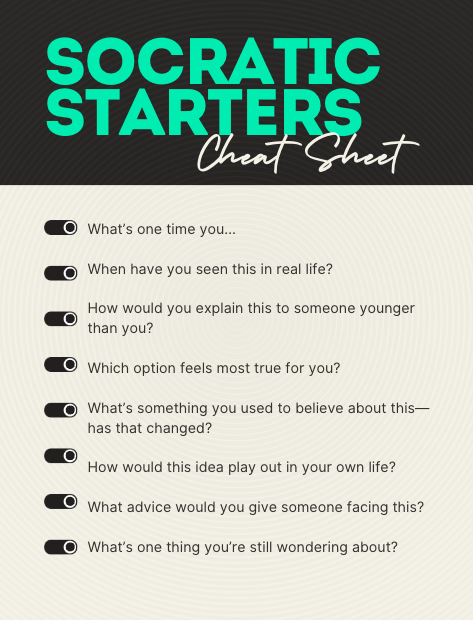
TL;DR: Ask better questions
- The Socratic Method deepens reflection through questions, not lecture
- It builds memory, autonomy, and emotional engagement
- It works with multiple choice, Likert, open response, and more on Edovo
- When in doubt, ditch the “right” answer and go for the real one
If you made it this far—and paused, nodded, or rethought a question along the way—you’ve already experienced the method.
That’s the point.
References
(Because yes, asking “Why does this matter?” means we show our work. Socrates would demand it.)
Bandura, A. (1977). Social learning theory. Prentice-Hall.
Brookfield, S. D. (2012). Teaching for critical thinking: Tools and techniques to help students question their assumptions. Jossey-Bass.
Craik, F. I. M., & Tulving, E. (1975). Depth of processing and the retention of words in episodic memory. Journal of Experimental Psychology: General, 104(3), 268–294.
Mezirow, J. (1991). Transformative dimensions of adult learning. Jossey-Bass.
Paul, R., & Elder, L. (2006). The Thinker’s Guide to the Art of Socratic Questioning. Foundation for Critical Thinking.
Yang, Y.-T. C., Newby, T. J., & Bill, R. L. (2005). Using Socratic questioning to promote critical thinking skills through asynchronous discussion forums in distance learning environments. American Journal of Distance Education, 19(3), 163–181.