(FOR CONTENT PROVIDERS) How to Design Courses That Adapt in Self-Paced Learning
Research-backed strategies for designing flexible, differentiated lessons that reach every learne.
Not everyone starts at the same line
Imagine three people opening your course.
One is locked in and flying.
One is curious but cautious.
One is rereading every sentence, wondering if this is about to be another reminder that school “wasn’t for them.”
Now imagine giving all three the same pace, the same prompts, the same expectations, and hoping for the same outcome.
That’s not equity.
That’s a fast track to dropoff.
On Edovo, you can’t pull someone aside. You can’t re-explain something out loud. You can’t adjust in real time.
But you can design a course that quietly adapts; one that flexes based on confidence, skill, and cognitive load, qithout ever speaking directly to the learner (or using fancy AI prompts).
That’s differentiation by design.
And this article shows you how to build it into the bones of your course.

What you’ll walk away with
What differentiation actually looks like in a self-paced, closed system
How to design for variability in skill, confidence, and cognitive load
Which Edovo tools already support learner choice and pacing
Concrete, copy-and-paste-ready ways to give your next course more range—and more reach.
The jargon you actually need to know
Term: Differentiated Instruction
What it is:
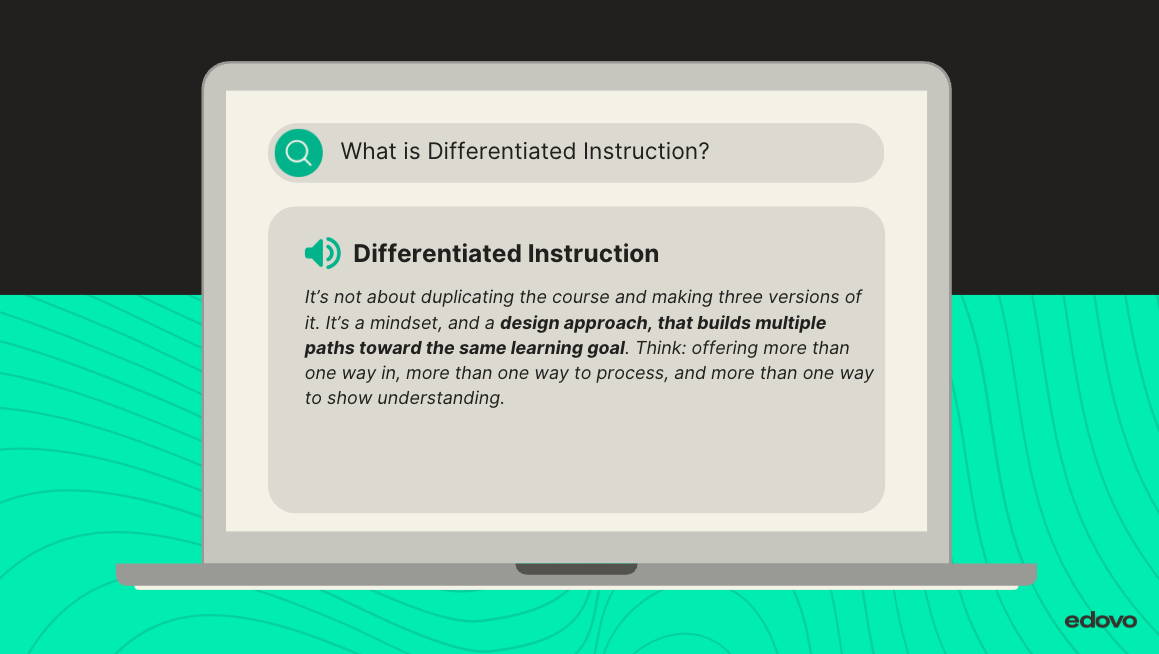
Differentiation is not making three versions of the same course. It’s a design mindset that builds multiple paths to the same learning goal.
Think:
More than one way in
More than one way to process
More than one way to show understanding
What the science says:
Differentiation improves engagement, self-efficacy, and long-term retention—especially for learners with interrupted education, academic trauma, or wide variation in prior knowledge (Tomlinson, 2001; Bransford et al., 2000).
For incarcerated adults, differentiation does something even more important:
It reduces shame, increases autonomy, and keeps learners from quietly opting out when things feel confusing or exposing.
In a system where support is limited and trust is fragile, motivation isn’t a bonus.
We don’t differentiate to make learning easier.
1. Vary the way in (how learners enter the lesson)
Learners don’t all engage the same way at the start. Offering more than one way into the content reduces early dropoff and helps learners orient themselves before cognitive load ramps up.
Offer text + optional video for key concepts
(“Prefer to watch instead of read? This short video covers the same idea.”)Start with a question or scenario before any definition
(“What usually happens when you feel disrespected?”)Use a single image or icon to signal the lesson theme
(Repeat it in headers or recaps so learners stay oriented.)Include a brief “What this is / why it matters” screen before the content
(2–3 plain-language sentences, max.)
2. Offer more than one reflection path
Reflection builds understanding, but only if learners feel safe enough to engage. Multiple reflection options let learners think deeply without forcing vulnerability or literacy skills too early.
Use multiple-choice or Likert questions before open response
(Low pressure, high engagement.)Provide sentence starters instead of blank text boxes
(“When I feel disrespected, I usually…”)Make reflection optional or private when possible
(“Think it through or write it down for yourself—no need to submit.”)Allow learners to choose one prompt instead of answering all for offline reflections
(“Pick the question that feels most relevant to you.”)Use short, focused prompts instead of broad, abstract ones
(One moment, one decision, one reaction.)
3. Scaffold with optional supports
Not all learners need the same level of help—and forcing support on everyone can slow strong learners down. Optional scaffolds let learners pull support when they need it, without being called out.
Add definitions or reminders before questions, not after
(“Quick refresher before you answer…”)Include recap screens learners can pause on or skim
(“Here’s what we’ve covered so far.”)Use practice questions that aren’t graded before assessments
(“Try this first—no pressure.”)Repeat key ideas using simpler language on recap screens
(Same idea, fewer words.)Place examples directly under instructions
(Show what a good response looks like.)
4. Let learners control pacing
Self-paced learning only works if learners can actually manage the pace. Clear structure and intentional pauses help learners stay regulated instead of overwhelmed.
Break content into short, clearly labeled sections
(So learners know where they are and what’s coming next.)Use preview screens before new or heavier concepts
(“Next up: handling conflict in the moment.”)Space quizzes away from dense content
(Don’t introduce five new terms and test immediately.)Add natural stopping points
(“This is a good place to pause and come back later.”)Avoid putting too many tasks on one screen
(One idea, one action.)
TL;DR: Differentiation isn’t fancy. It’s thoughtful.
Offer multiple ways in: image, scenario, question
Give learners more than one way to reflect
Scaffold quietly with previews, recaps, and supports
Pace the experience—don’t test endurance
Keep it challenging and doable
Design like your learner has something to prove—to themselves, not to you.
References
Bransford, J. D., Brown, A. L., & Cocking, R. R. (Eds.). (2000). How People Learn: Brain, Mind, Experience, and School: Expanded Edition. National Academy Press.
https://doi.org/10.17226/9853
CAST. (2018). Universal Design for Learning Guidelines Version 2.2.
http://udlguidelines.cast.org
Deci, E. L., & Ryan, R. M. (1985). Intrinsic Motivation and Self-Determination in Human Behavior. Springer.
https://doi.org/10.1007/978-1-4899-2271-7
Hammond, Z. (2015). Culturally Responsive Teaching and The Brain: Promoting Authentic Engagement and Rigor Among Culturally and Linguistically Diverse Students. Corwin.
Merrill, M. D. (2002). First principles of instruction. Educational Technology Research and Development, 50(3), 43–59.
https://doi.org/10.1007/BF02505024
National Research Council. (2012). Education for Life and Work: Developing Transferable Knowledge and Skills in the 21st Century. The National Academies Press.
https://doi.org/10.17226/13398
Tomlinson, C. A. (2001). How to Differentiate Instruction in Mixed-Ability Classrooms (2nd ed.). ASCD.